Relying on a single cloud provider can create risks in case of outages, pricing changes, or service limitations. That’s why modern companies are increasingly adopting a Multi-Cloud strategy to distribute their services across multiple cloud providers.
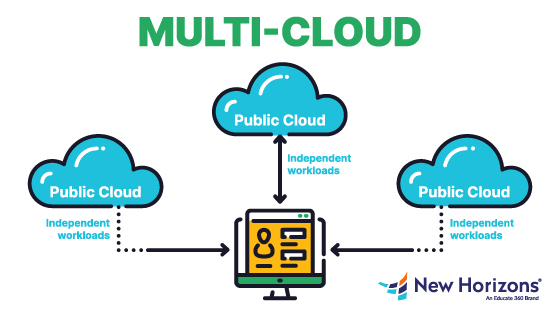
Multi-Cloud refers to using more than one cloud service provider within the same infrastructure.
For example, combining:
Avoid complete service disruption if one provider experiences issues.
Choose the best provider for each specific service or workload.
Take advantage of different pricing models and offers.
Distribute services across multiple geographic regions and providers.
Combines private cloud and public cloud environments.
Uses multiple cloud providers simultaneously.
Each provider has its own tools and services.
Tracking systems across different platforms becomes harder.
Unifying security policies across providers is not easy.
Not always. It depends on the project size and business requirements.
Sometimes, but it can also reduce risks and improve performance.
 Conclusion
Multi-Cloud helps companies improve flexibility, stability, and resilience while reducing dependence on a single cloud provider.
 2019 - 2023 © WELNIZ.LTD. All rights reserved.

 United Arab Emirates (Arabic)
 Worldwide (English)