What Is Service Mesh and Why Do Modern Applications Need It???
Introduction
With the rise of Microservices architecture, managing communication between services has become increasingly complex. This is where the concept of Service Mesh comes in, helping modern applications improve control, monitoring, and security.
What Is Service Mesh?
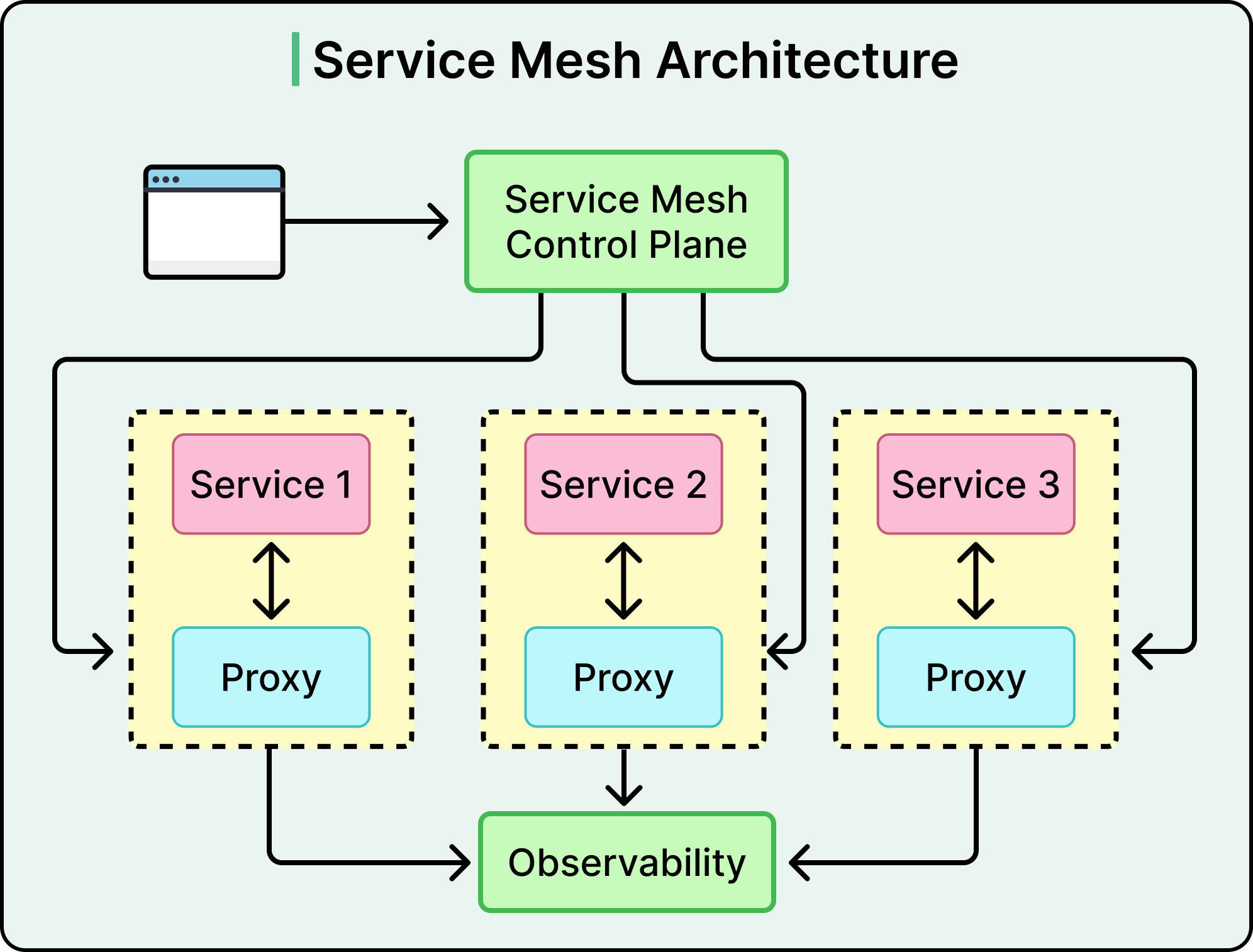
Service Mesh is a dedicated infrastructure layer that manages communication between services inside an application without requiring changes to the application code itself.
How Does It Work?
A small proxy is deployed alongside each service in the system. This proxy is responsible for:
- Managing service-to-service communication
- Encrypting data traffic
- Monitoring performance
- Distributing requests efficiently
Why Do Modern Applications Need Service Mesh?
Improved Security
It supports encrypted communication between services.
Better Monitoring
Provides detailed insights into application performance.
Load Balancing
Helps manage traffic flow efficiently.
Traffic Control
Allows flexible request routing and traffic management.
Popular Service Mesh Tools
Difference Between API Gateway and Service Mesh
API Gateway
Handles external client requests.
Service Mesh
Manages internal communication between services.
When Do You Need Service Mesh?
- Large-scale applications
- Microservices environments
- Kubernetes-based systems
Disadvantages of Service Mesh
- Adds operational complexity
- Requires additional system resources
- Needs technical expertise to manage
FAQ
Is Service Mesh necessary for every project?
No. It is mainly useful for complex systems with many interconnected services.
Does it only work with Kubernetes?
No, but it is very commonly used with Kubernetes environments.
Conclusion
Service Mesh has become an essential part of modern application architecture because it provides better control, enhanced security, and improved observability between services.
 2019 - 2023 © WELNIZ.LTD. All rights reserved.

 United Arab Emirates (Arabic)
 Worldwide (English)