Your infrastructure may consist of powerful servers and high-speed networks, yet you still experience unexpected slowdowns from time to time.
In many cases, the root cause is a phenomenon known as Head-of-Line (HOL) Blocking, one of the most common performance challenges in networking and distributed systems.
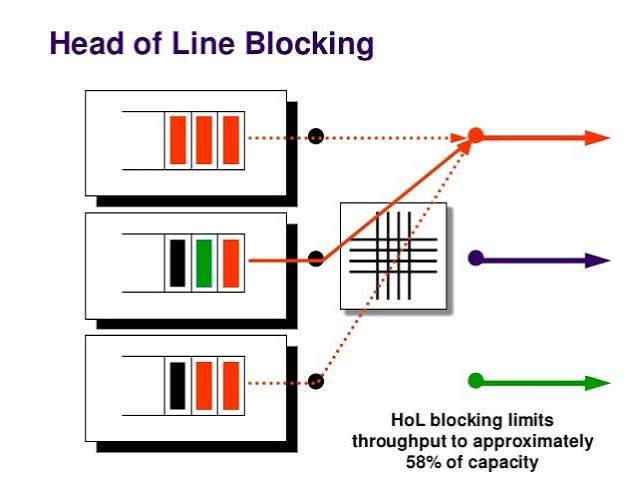
Head-of-Line Blocking occurs when a slow request or operation prevents other requests from making progress, even though they are ready to be processed.
In simple terms:
One request stuck at the front of the queue delays all the requests behind it.
Imagine a queue at a bank:
Despite the simplicity of the remaining transactions, everyone must wait for the first customer to finish.
This is essentially how Head-of-Line Blocking works in computer systems.
Especially in older versions of HTTP and other protocols that process requests sequentially.
When long-running queries block other operations from accessing shared resources.
If messages are processed strictly in order, one slow message can delay all subsequent messages.
When lengthy input/output (I/O) operations hold up other requests waiting for access.
Even fast requests experience longer response times.
Fewer operations can be completed within a given period.
Queued requests accumulate, increasing memory and system overhead.
HTTP/2 introduced Multiplexing, allowing multiple requests and responses to be transmitted concurrently over a single connection.
This significantly reduces the impact of application-layer Head-of-Line Blocking compared to HTTP/1.1.
Execute independent tasks simultaneously rather than sequentially.
Separate workloads into multiple queues based on priority or task type.
Reduce the execution time of slow database operations.
Adopt technologies such as:
These protocols are designed to minimize blocking and improve concurrency.
No.
It can occur in databases, message queues, storage systems, operating systems, and many other environments where tasks compete for shared resources.
HTTP/3 significantly reduces transport-layer Head-of-Line Blocking by using the QUIC protocol and independent streams.
While it addresses a major portion of the problem, other forms of Head-of-Line Blocking can still exist at the application or infrastructure level.
Head-of-Line Blocking is a performance issue that often hides behind seemingly unexplained slowdowns in modern systems. A single slow operation can create cascading delays that affect many other requests. Designing systems with parallelism, efficient queuing, optimized workloads, and modern communication protocols is essential to prevent one bottleneck from slowing down the entire infrastructure.
 2019 - 2023 © WELNIZ.LTD. All rights reserved.

 United Arab Emirates (Arabic)
 Worldwide (English)