As applications grow and user traffic increases, databases often become one of the most heavily utilized components of the system. In many cases, the primary challenge is not write operations but the large volume of read requests.
This is where Read Replicas provide an effective solution for improving performance and distributing database workloads.
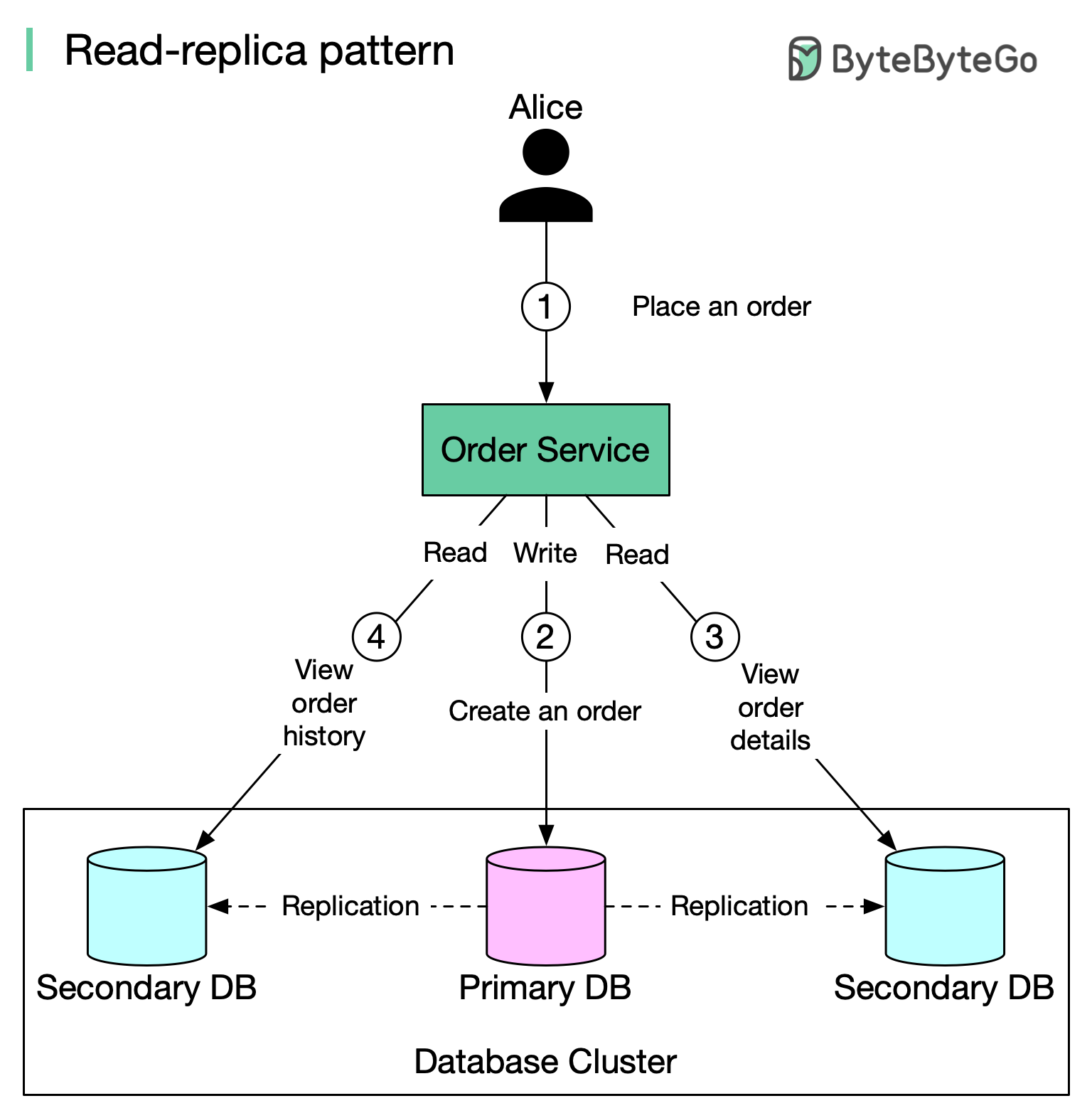
A Read Replica is a copy of the primary database that is continuously synchronized with the main database server.
These replicas are used exclusively for handling read requests, while all write operations continue to be processed by the primary database.
When new data is written:
This separation allows the database workload to be distributed more efficiently.
Read operations are offloaded from the primary database, reducing overall system load.
Additional replicas can handle large numbers of concurrent read requests.
Applications with read-heavy workloads can serve data more quickly.
New replicas can be added as demand grows without significantly modifying the application architecture.
Read Replicas are commonly used in:
These applications often generate far more read operations than write operations.
Newly written data may take a few seconds to appear on replicas, depending on the replication method and workload.
Managing multiple database instances requires additional monitoring, maintenance, and operational planning.
Applications must account for scenarios where a replica may temporarily contain slightly older data than the primary database.
Automatically distribute read traffic across multiple replicas.
Track synchronization latency to ensure data remains reasonably up to date.
Never send write operations to read-only replicas unless specifically supported by the database architecture.
Add or remove replicas according to traffic patterns and workload requirements.
In most database architectures, no. Read Replicas are designed primarily for read-only workloads, while write operations are handled by the primary database.
No. They are an effective way to improve read performance, but additional scaling strategies may still be needed as applications continue to grow.
Read Replicas are one of the most widely used database optimization techniques for improving performance and reducing load on the primary database server
 2019 - 2023 © WELNIZ.LTD. All rights reserved.

 United Arab Emirates (Arabic)
 Worldwide (English)