With the widespread adoption of Microservices, modern applications are now composed of dozens or even hundreds of independent services. While this architecture improves scalability and development flexibility, it also makes communication between services significantly more complex.
This is where the concept of a Service Mesh emerged as a solution for managing service-to-service communication in a centralized, secure, and efficient manner.
A Service Mesh is an infrastructure layer responsible for managing data traffic between different services within an application.
Instead of embedding communication, security, and monitoring logic into each service, these responsibilities are moved to a dedicated infrastructure layer.
As the number of services grows, several challenges arise, including:
Implementing these capabilities within every service can significantly increase complexity.
A Service Mesh typically relies on components called Sidecar Proxies.
A proxy runs alongside each service and is responsible for managing:
All of this happens without requiring changes to the application code itself.
Automatically encrypts communication between services.
Provides detailed metrics and insights into service performance.
Enables flexible routing, load balancing, and traffic control.
Offers clear visibility into how requests move throughout the system.
Some of the most widely used Service Mesh platforms include:
A Service Mesh becomes valuable when:
No. Small applications and simple architectures often do not require a Service Mesh.
It may introduce a small amount of overhead, but the operational, security, and observability benefits often outweigh the cost.
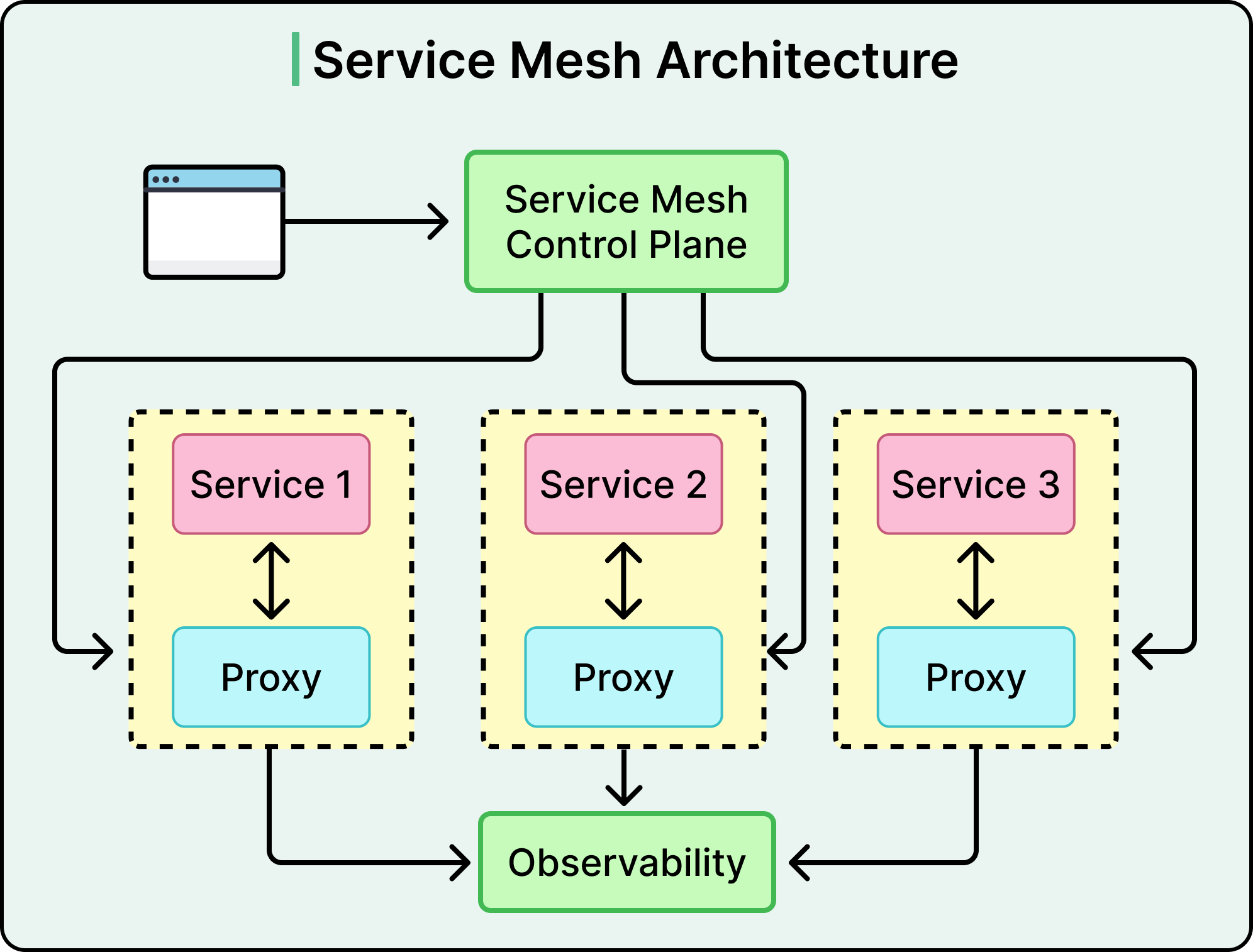
A Service Mesh simplifies communication management within distributed systems by providing a dedicated layer for security, monitoring, and traffic control. This allows development teams to focus on building business functionality while maintaining reliable and secure service interactions.
 2019 - 2023 © WELNIZ.LTD. All rights reserved.

 United Arab Emirates (Arabic)
 Worldwide (English)