As the volume of data continues to grow, storing everything in the same way has become both expensive and inefficient. To optimize storage costs and performance, modern organizations classify data based on how frequently it is accessed into Hot Data and Cold Data.
Hot Data refers to information that is accessed frequently and requires fast retrieval.
Because this data is constantly in use, it is typically stored on high-performance storage systems.
Cold Data refers to information that is rarely accessed but still needs to be retained for business, legal, or compliance purposes.
Since access is infrequent, Cold Data is usually stored in lower-cost storage solutions.
Storing all data on high-performance, premium storage can significantly increase costs without providing additional value.
Instead, organizations allocate:
This approach helps balance performance requirements with budget constraints.
Organizations pay only for the performance level each type of data requires.
Frequently accessed data remains readily available with minimal latency.
Premium storage resources are reserved for business-critical workloads rather than rarely used information.
The fastest and most expensive storage tier, designed for frequently accessed data.
A middle-ground option that balances performance and cost.
Lower-cost storage intended for infrequently accessed data.
Designed for long-term retention with the lowest storage costs and slower retrieval times.
The Hot Data and Cold Data model is widely used in:
Most cloud providers offer multiple storage classes that allow organizations to place data in different tiers based on usage patterns and access frequency.
This helps businesses optimize both storage performance and operational costs.
Yes. If previously archived or rarely used data starts being accessed more frequently, it can be moved to a higher-performance storage tier.
Yes. Cold Storage is commonly used for long-term retention and often includes robust durability and security mechanisms.
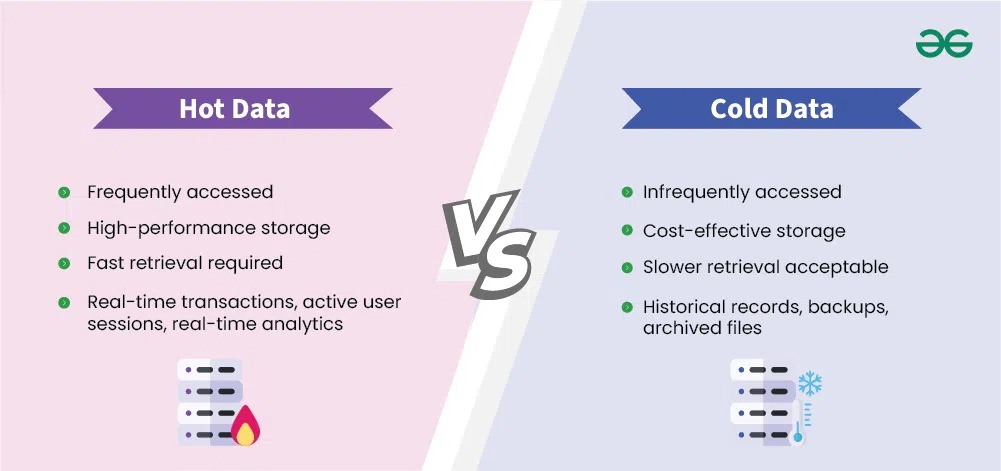
Classifying information into Hot Data and Cold Data enables organizations to strike the right balance between performance and cost. By storing data according to its usage patterns, businesses can optimize storage resources, improve efficiency, and reduce long-term infrastructure expenses.
 2019 - 2023 © WELNIZ.LTD. All rights reserved.

 United Arab Emirates (Arabic)
 Worldwide (English)