Observability: How to Detect Server Problems Before They Happen???
HomepageArticlesObservability: How to Detect Server Problems B...
Observability: How to Detect Server Problems Before They Happen???
Introduction
With the increasing complexity of modern systems and the widespread use of cloud services and Microservices, detecting technical issues has become much more challenging. That’s why Observability has become one of the most important concepts in modern infrastructure monitoring.
What is Observability?
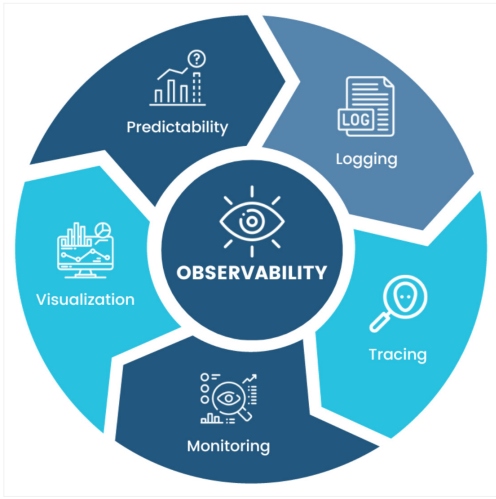
Observability is the ability to understand the internal state of a system by analyzing the data it generates during operation.
The 3 Core Pillars of Observability
Logs
Records of events, activities, and errors inside the system.
Metrics
Performance measurements such as CPU usage, memory consumption, and response times.
Traces
Tracking requests as they move between different services inside the system.
Difference Between Monitoring and Observability
Monitoring
Focuses on detecting known issues using predefined alerts.
Observability
Helps discover unexpected problems and analyze their root causes.
Why is Observability Important?
Faster Problem Detection
Helps identify system failures before they become critical.
Performance Optimization
Makes it easier to discover bottlenecks and weak points.
Better User Experience
Problems can often be fixed before users even notice them.
Popular Observability Tools
Prometheus
Grafana
Elastic Stack
Datadog
When Do You Need Observability?
Observability is especially useful for:
Microservices architectures
Cloud-native applications
Large-scale systems
High-traffic platforms
Challenges
Handling huge amounts of data
Requires careful configuration
May increase resource consumption
FAQ
Is Observability a replacement for Monitoring?
No. Observability is considered a more advanced evolution of traditional monitoring.
Do small projects need Observability?
Usually not at the beginning, but it becomes important as systems grow.
Conclusion
Observability has become an essential part of managing modern systems because it helps detect issues early, improve performance, and maintain reliable user experiences continuously.
 2019 - 2023 © WELNIZ.LTD. All rights reserved.

 United Arab Emirates (Arabic)
 Worldwide (English)