Imagine thousands of users requesting the same piece of data at exactly the same moment, such as a live sports score or the price of a popular product during a major sale. If the system processes every request independently, it can place enormous pressure on backend services and databases.
This is where Request Coalescing comes in—a smart technique designed to reduce unnecessary workload and improve system performance.
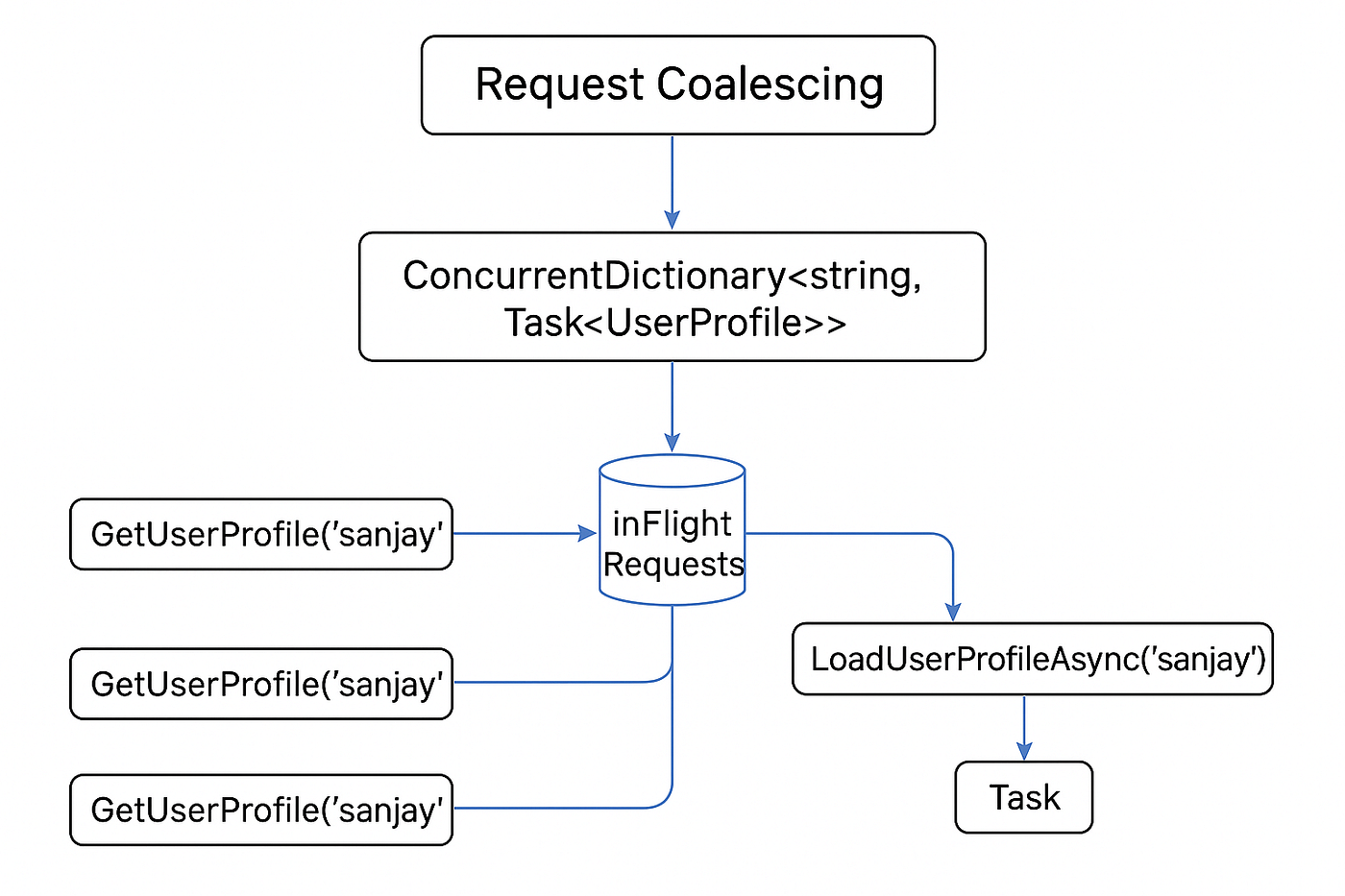
Request Coalescing is a technique that combines identical requests arriving at the same time and processes them only once.
Once the result is available, it is shared with all waiting requests instead of generating duplicate operations.
Instead of sending:
The system:
This dramatically reduces redundant work and resource consumption.
Suppose 500 users request the homepage at the same second, and generating the page requires an expensive database query.
The outcome is faster response times and lower backend load.
Fewer database queries and backend operations are required.
Users receive responses faster because duplicate work is eliminated.
CPU, memory, and database resources are used more efficiently.
Systems remain more resilient during traffic spikes and peak usage periods.
Request Coalescing is frequently implemented in:
Any environment with frequent requests for the same data can benefit from this technique.
Caching reduces requests by storing previously retrieved data and serving it directly from memory or fast storage.
Request Coalescing prevents multiple identical requests from triggering duplicate backend operations while the data is being fetched.
For this reason, the two techniques are often used together to maximize performance and efficiency.
Requests must be coordinated correctly to ensure they share the same result.
Special care is needed when the primary request fails, as multiple waiting requests may depend on its outcome.
Implementing Request Coalescing can add complexity to application logic, especially in distributed systems.
No. It complements caching rather than replacing it. The two techniques work best when used together.
No. Any application that receives multiple requests for the same data can benefit from Request Coalescing, regardless of size.
Request Coalescing is a powerful optimization technique that reduces unnecessary workload by combining identical requests and processing them only once. By minimizing duplicate operations, organizations can improve performance, reduce resource consumption, and maintain system stability during periods of high demand.
 2019 - 2023 © WELNIZ.LTD. All rights reserved.

 United Arab Emirates (Arabic)
 Worldwide (English)